Monday, March 31, 2014

you are more then this body ( the 5 Koshas )

 
A Bit of an intro.
According to yoga, individual consciousness is a partial expression of cosmic consciousness. 
Cosmic consciousness and individual consciousness are one. 
Only subjectivity separates them. it is out of Consciousness that the ultimate reality of which mind and matter proceed. 

consciousness exists in everything, from minerals to man. 
 the human body is the most highly evolved Of all existing bodies that express themselves through behavior. It is capable of self-expression and the realization of Truth beyond the realm of sensory perception. With the help of memory, imagination and intuition, the human organism can understand laws inherent in nature and use them for its growth and development. 


When consciousness desires expression as an organism, it needs tools to control and work with the physical body.

 Annamayi Kosha (Sheath of Matter)
The main centers of consciousness in the human body are in the brain and the spine. 
The cerebrospinal system is the first part of the organism to be developed after conception. 
From it the entire bodily form comes out. This system is a great generator of electrical energy that is constantly supplied to the internal organs by a network of nerves that serve as connectors. 
The functiong of the entire human body is controlled by the cerebrospinal system, and the psychic centers are located in it. 

Inside the big company of the body there is a branch, a side office, in which mind is the boss. 
Mind has a practical tool in the body which is the brain. Brain uses breath, and breath uses nerves, and nerves are dealing with the five sense organs (eyes, ears, nose, tongue, and skin), and the five work organs (anus, genitals, legs, hands, and vocal chords). 
So the combination of brain, breath, nerves, sense organs, and work organs form a unit inside the body which is working with the mind. 

 Pranamayi Kosha (Sheath of Vital Air)
Prana or energy is the moving force. 
This sheath of Vital Air supplies energy to the whole system and keeps it alive. 
Prana refers not only to the flow of oxygen but to all components of life force. 
This energy enters each and every cell and each and every pore. 
Breath is the physical counterpart of the mind. All neuromotor activities, all sensory and motor functions of the body, are performed with the help of the breath. 

Breath provides the pranic force to the organism. This pranic force, working as the Air element, creates movement, pulsation, vibration and life. The science of controlling prana is known as pranayama, a branch of Hatha Yoga. By mastering prana one can master the mind. By practicing pranayama, the breath becomes calm, images do not disturb the mind, and the internal dialogue stops

 Manomayi Kosha (Sheath of Mind)
Mind is the tool of consciousness that enables us to perceive the world and process the incoming information. The world exists in front of us, because of our five senses. There are organisms without brain and eyes and ears, only tactile sensation is there through the skin. If you touch them, they react. Even though they have no brain these organisms have perception of the world because they have mind. Most of the time, people think that mind is the functional aspect of brain, however, mind and brain are two different things

Mind is using brain as tool. Mind is pervaded in everything, it's in every cell, everywhere, it has no specific seat. It's not the same as god, but it has similar character being present everywhere.
Mind is the greatest obstacle in the way of systematic thinking. It jumps from one point to other point by finding similarity in that point. Anything which is similar immediately reminds the mind of something else, and from this field he jumps into some other field, and then he starts talking about something else and the whole point is being lost. Most of the time only one is dominant and that is mind. But sometimes ego is also very dominant. And intellect is only in the beginning, when you start, at that time it comes and tries to show you how to go, but after that, mostly it is the mind which takes the lead. 

Ego, mind, intellect, and the self (together 3 of 5 koshas), travel from one body to other body, from one life to other life, as long as there are attachments, likes and dislikes, ego continues for the fulfillment of desires.

Vigyanamayi Kosha (Sheath of Ego and Intellect )
Within the 5 koshas division of our psychology, around the sheath of Bliss is sheath of Knowledge, that combines ego and intellect. Ego is the tool of consciousness which links all events in life together. Ego is the illusion that I exist as a separate individual being, it is false identification. 

Ego is the one which assumes the responsibility for the body. Ego says, "This body is mine". When the body breathes, he says, "I am breathing". And if you close his nose then he says, "You are suffocating me, I am dying". Ego is very sensitive and the fear of death is always there. Ego takes a name, and becomes Mr. such and such and it interacts with others.
Whatever you experience in this life or in past lives, and whatever information you got from your parents, from your society, from the race, from the country to which you belong, all that information combined together becomes intellect
It gets a part of the genetic information from seven generations of the father, and seven generations of the mother. Intellect carries with it the past and the present, and also speculates about the future. Intellect helps ego with advice and comments but the final decision comes from ego. Ego can say, "I like it" and although intellect may disapprove ego may decide "O.k., I don't believe that this is right, but I don´t want to follow all these rules and regulations, I'll break the law". 

Strong attachments and the struggle for survival increase the ego. In modern schools there is competition all the time. Who does it first? Who is the best? Ego always tries to say, "I am better than you", "I am holier than you". In ancient days they had an education system that did not let the ego grow beyond a particular limit. The child had to go and live with the family of a teacher as a member of the family (gurukul). The wife of the teacher was responsible for providing all food, and nobody was allowed to bring other food. And parents were not allowed to bring gifts in order to treat all pupils equal, and make them feel that everyone is equal.

Anandamayi Kosha (Self seated in Sheath of Bliss) 
The human consciousness is folded in these five layers, or sheaths, (koshas) around the central point, containing the self (chitta). The self is enveloped in the sheath of bliss. 
Both the self and the bliss are not experienced although they are always there, and always protected from all sides. Nothing is disturbing to the self, because nothing is real for the self. 
The self is the truth, and truth is never changing. Whatever else is happening, is all changing every minute. 
The self knows this is not real, this is ever changing, this is illusion.
in other words, the self is watching the movie that you THINK you're in. ;)

NAMASTE

Monday, March 17, 2014

6 yoga poses for pain relief

Many people suffer from back pain
Yes, some of us have injuries from accidents or physical strain related causes, BUT, many of us are feeling pain as a result of mental and emotional stresses that over time lead to pain due to holding on to stress IN OUR BODY'S. pore posture habits sometimes as a result of long hours in chairs at work or home also lead to pain.
SOOOOOOO... the pain I am refering to here is BACK pain DUE TO pressure on the SPINE and/or NERVES.

Yoga is more of a preventive practice, an opportunity to LET GO of things and at the same time keep the body and mind active and healthy but it can be used for therapy as well and even pain relief in some cases, even some practices of meditations can heal the body but this is another Blog altogether, I'll just say this for now; "MIND OVER MATER" (it's the mind the caused the pain to begin with)
ANYWAY...
YOGA POSES to relieve PAIN


1. Downward-Facing Dog

 Downward-Facing Dog
This classic pose is excellent for total body stretch, spinal traction and maintaining lower back health.
keep your spine neutral. Tilt your tailbone towards your heels, push heels to floor and press back through your legs.
Extend your spine and head towards the space between your hands.

2. Uttanasana - Forwards bend
there are MANY variations, as with all yoga poses, and the main thing to keep in mind is EASY DOSE IT!! don't push the pose, let it happen, if you are tight, keep knees bent and even rest your hands on thighs above knees. try to relax the neck and slowly let go... lifting tail bone to sky, dropping head down and stay for a while... in the breath. This will lengthen and relax the back mussels, relieving tension from the vertebra's as well.     

3. Plank (Modified for Standing)

Stand in front of a wall with your hands flat against it. Keep your fingers wide, fingertips pointing towards the ceiling.
Draw your navel back as you lengthen your tailbone towards the floor. Lift your ribs from the pelvis. The goal here is to keep your low back as neutral as possible, using your core muscles to help stabilize your posture.
Keep your spine aligned while you walk your legs back. Bend at the waist and walk your hands down the wall as you go. Eventually your body will form the shape of an ‘L’. If you feel any pain or stress in your lower back, bend your knees to maintain the proper spinal alignment.
Maintain this pose for the length of 10-15 breaths. It will help build strength in your core muscles, thereby taking some of the load off of your spine, while supporting length and flexibility in your back muscles.

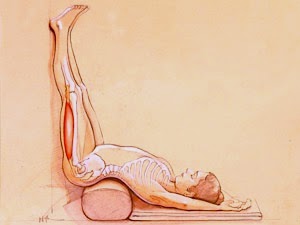
4. Legs Up the Wall (Viparita karani)


If you are using a bolster or pillow, place it under your hips and lift your legs up a wall. Otherwise, lie with your tailbone as close as possible to the wall and lift your legs.
Flex your toes towards your body and extend your arms out to your sides with your shoulders pulled back so that your shoulder blades are as flat against your mat as possible.
Relax and breathe deep into your belly.
This pose releases low back pressure, elongates the spine, and develops flexibility of the leg muscles and ligaments that helps support a natural, back-healthy gait.

5. CAT COW POSE
Inhale look up, drop belly and lift tail bone
Exhale forehead to hips, hips to forehead and arch back to sky
do a few SLOW rounds and rest in Child's pose.. then again...
This pose incises mobility of the spine, stretches the front torso and neck and even Provides a gentle massage to the belly organs.


6. Child POSE
Child
Use any variation for this pose and even some pillows or bolsters to make yourself comfortable.
Your knees can be wide apart or closed, arms stretching or folded next to feet, palms up.
head on floor, or pillow... what ever, just make it so you are RELAXED
Breathe into your back as you inhale and exhale deeply.
Breath in to the belly and lower back... go deeper with each breath and release tension with each exhale
Feel the space between each vertebra grow as you relax deeper into the pose.

"pain is inevitable suffering is optional"
may all beings be free from suffering!
Namaste ;)
SjD


Monday, March 10, 2014

Things to know about Shiva


Lord Shiva:
Maheshwara...Shankara.
Attributes: Unclad body smeared with ashes: This form of Lord Shiva symbolizes the transcendental aspect of his nature and indicates that his presence is much higher than this physical phenomenon.

Jata (Matted Hair): The flow of his matted hair represents Shiva as the Lord of Wind or Vayu, who is the subtle form of breath present in all living beings. It shows that Shiva is Pashupatinath, Lord Of All Living Beings.

Sacred Ganga: The river Ganga (or Ganges) is the most sacred river for pious Hindus. According to a legend, the river Ganga has its source in Shiva and flows from his matted hair. This is symbolically represented by depicting Ganga as a jet of water sprinkling out of the head of the Lord and falling on the ground.

The Third Eye: In the great Hindu epic Mahabharata, Lord Shiva is depicted as a three-eyed God. Hence, he is often referred to as Tryambaka Deva, meaning "three-eyed Lord". The sun is said to be his right eye, the moon the left eye while fire is his third eye.

Half-Open Eyes: The half-open eyes signify that creation is going through an eternal cyclic process, with no beginning and no end.

Crescent: Lord Shiva is typically pictured as wearing a crescent-shaped ornament on one side of his head. This is why he is often called 'Chandrasekhara' meaning "Having the moon as his crest". The Crescent is actually the moon in its fifth day phase and symbolizes the time cycle through which creation evolves from the beginning to the end.

The Snake around the neck: Lord Shiva is often shown with a snake curled three times around His neck and looking towards His right side. The three coils of the snake symbolize the past, present and future - time in cycles.

Vibhuti: The three line of ashes drawn on the forehead of the Lord is known as the Vibhuti. It signifies the Immortality of the Lord and his manifested glory.

Tiger Skin: Hindu mythology states that the tiger is the vehicle of Shakti, the Goddess of power and force. Lord Shiva is often shown seated upon or wearing a tiger skin, which emphasizes the fact that he is the master of Shakti and is beyond and above any kind of force.

The Elephant and Deer Skin: The Lord also wears elephant and deer skins. Elephants stand in for pride while deer represent the flickering mind. Wearing elephant and deer skin shows that Lord Shiva has conquered both these vices.

Rudraksha Necklace: He is almost always shown as wearing a necklace having 108 beads made with seeds of the Rudraksha tree. The beads represent the elements used in the creation of the world.

Damaru (Drum): It is the small hourglass-shaped drum that the Lord holds in one of his hands in a specific gesture called 'damaru-hasta'.When a damaru is shaken, it produces Nada, the cosmic sound of AUM, which can be heard during deep meditation. According to Hindu scriptures, Nada is the source of creation. This is one of the attributes of Shiva in his famous dancing representation known as Nataraja.

Trishul (Trident): The trident, or the spear with three prongs, is one of the accessories of the Lord and symbolizes His three fundamental powers iccha(will), kriya(action) and jnana(knowledge).

Kamandalu: The water pot (Kamandalu) often shown adjacent to the Lord is another of his accessories. It is said to be made from a dry pumpkin and containing amrit (nectar).

Kundalas: The Kundalas refer to the two ear rings, Alakshya (meaning "which cannot be shown by any sign") and Niranjan (meaning "which cannot be seen by mortal eyes"), worn by the Lord. The ornaments in the ears of the Lord signify that He is beyond ordinary perception. It is noteworthy that the kundala in the left ear of the Lord is of the type used by women and the one in His right ear is of the type used by men. The dual type of Kundalas represent the Shiva and Shakti (male and female) principle of creation.

Mount Kailasa: Lord Shiva is most often shown to be seated with the beautiful Himalayas serving as his backdrop. Mount Kailash in the Himalayas is said to be His traditional abode. In Hindu mythology, Mount Kailasa is said to represent the center of the universe. This denotes that Lord Shiva is 'Kailas' - the bestower of peace and also 'Kailashadhipati' meaning "Lord Of Mount Kailash".

Nandi, the Bull: Nandi is the Bull of Lord Shiva and is said to be his vehicle. The bull is a symbol both of power and ignorance which suggests that Lord Shiva removes ignorance of his devotees and gives them the power of wisdom. In Sanskrit a bull is called "Vrisha" which also means "righteousness". The Nandi bull beside Lord Shiva indicates that He is the eternal companion of righteousness.


SHARED BY ; Durai Rajan @ guggle +
https://plus.google.com/u/0/+durairajantvvn/posts

Namaste ;)

Sunday, March 2, 2014

The meaning of Om


What is OM?


OM is the beginning of the universe

In the beginning there was only Brahman.
Brahman is infinite.
Brahman is the absolute.
Brahman is the Supreme Self.
Brahman is beyond space, time and causation.
Brahman is satchidananda: being, consciousness and bliss.

Brahman is our individual true Self.
All is Brahman.

Brahman brought forth the universe and everything in it.
From Brahman came the many.

This is beautifully described in the words of the Chandogya Upanishad:

“In the beginning was only Being, One without a second. Out of himself he brought forth the cosmos and entered into everything in it. There is nothing that does not come from him. Of everything he is the inmost Self. He is the truth; he is the Self Supreme. You are that, Svetaketu, you are that.”


OM is the sound of the beginning of creation.
OM is the first vibration that came from Brahman.
OM is the primal sound.

With OM Brahman created the universe and everything in it.
The name of Brahman and everything in creation is OM.

We do not create OM by chanting the name, but our chants produce a vibration that is in harmony with the cosmic sound that has been vibrating from the beginning. That is the secret of the power of OM.

Our chanting of OM resonates with the eternal vibration of Brahman. Om is like a divine tuning fork vibrating into eternity.

Why do we chant OM?

We chant OM to connect with our true Self. Since our true Self is the same as the Supreme Self, when we connect with our true Self we connect with the Supreme Self.

When we chant OM it produces a vibration in us which resonates with the universal vibration of OM, and we are elevated from our everyday minds to relationship with our true Self. We chant OM to be in tune with the true Self.

When we chant OM it puts us in a meditative mood. When we chant OM our minds become calm and we can rest in our true Self.

OM is the supreme mantra

All mantras begin with OM. OM is the supreme mantra.

Chanting OM calms and purifies our minds and helps us rest in our true Self.
If we chant OM we become filled with divine energy. It is like taking divine medicine.

In Yoga Sutra 1.28, Patanjali said “Let there by chanting of OM with meditation on its meaning.” By chanting OM our minds become still, and our true Self shines forth.

Chanting OM is the path of bhakti yoga or the path of devotion. Chanting OM helps us unite with the Supreme Being.

OM is a trilogy of meaning meanings

OM is comprised of three sounds: “A”, “U” and “M”. There is also a fourth sound which is a universal vibration and is the essence of all other sounds. This fourth sound is known as the un-struck sound.

OM is comprised of three letters and represents many trilogies of meanings.

Here are some examples:

A U M
Brahma Vishnu Shiva
Creation Preservation Destruction
Body Mind Soul
Rajas Sattva Tamas
Sat Chit Ananda
Past Present Future
Birth Life Death
Jagrat Svapna Sushupti
Father Mother Sun
Fire Sun Wind


OM is consciousness

OM is the four states of consciousness.

OM is the waking state or jagrat.
OM is the dreaming state or svapna
OM is the deep sleep state or sushupti.
Om is the transcendental state or turiya.

The three curves of the OM symbol represent jagrat, svapna and sushupti.

The large curve at the bottom represents jagrat. It is the largest curve because we spend most of our time in the waking state.

The smaller curve above it represents the deep, dreamless state or sushupti.

The curve in the middle represents the dreaming state or svapna because it is an intermediate state between the waking state and the dreamless state.

The dot (or bindu) signifies the fourth state of consciousness or turiya. In this state consciousness looks neither outward nor inward. This peaceful and blissful state is the ultimate aim of all spiritual activity. This state illuminates the other three states.

Finally, the semi-circle symbolizes maya and separates the dot from the other three curves. It is the illusion of maya that prevents us from the realization of this highest state of bliss. The semi-circle is open at the top and does not touch the dot. This means that this highest state is not affected by maya. Maya only affects the manifested phenomenon.

Chanting OM causes our mind to become still, sets up harmonious vibrations in our mind and subtle body, elevates our mind to divinity, and raises our consciousness to the transcendental state of turiya. We unite with the Supreme Self.

Resources

One of the best resources on OM is the Mandukya Upanishad. It is quite short- only 12 stanzas- but is considered one of the deepest and most important of the Upanishads. Swami Krishnananda has published a free book in PDF form which contains the Mandukya Upanishad and his commentary. Here is the link to the book:

www.swami-krishnananda.org/mand/Mandukya_Upanishad.pdf


The Yoga Sutras contain two Sutras on OM: Sutra 1.27 and Sutra 1.28.

Sutra 1.27 states that the sacred word representing Isvara (the Supreme Being) is OM (pranava).

In Sutra 1.28 Patanjali gives us an important teaching for our practice: “Let there be the chanting of OM with meditation on its meaning.” If we read the two together we learn that meditation on the Supreme Being is an important path to realizing our true Self. It is the path of bhakti yoga or the yoga of devotion.


I sat alone on a block of stone
On the banks of the Ganges.
Mother Ganges blessed me.

I meditated on OM and its meaning–
The Word that is the symbol of Brahman.

The little personality was lost.
The mortal limit of the self was loosened.

But there was infinite extension.
I entered into the Nameless beyond;
I realized the unity of bliss.

No words can describe the thrill of joy,
The mystic experiences,
The supreme and divine height of felicity!

The little “I” fused into the incandescent brilliance.

Two become one now,
It was all Tejomaya Ananda–
One mass of transcendental light bliss.

Sri Swami Sivananda

Thursday, February 27, 2014

Chakras in the Body by Ram Dass

If you think in terms of chakras, or energy systems in the body or connected with the body, there is the first, second, third, fourth, fifth, sixth and seventh, which are called the muladhara, sradhishthana, manipura, anahata, vishuddha, anja, and sahasrara. The first one is in the bottom of the spine, the second is sort of below the navel, the third is at the navel, the fourth is in the heart region, the fifth is at the throat, the sixth is between the eyebrows, the seventh is on the top of the head. These don’t necessarily have any physiological correlates. They’re just psychic localizations of psychic energy, let’s put it that way, in this Hindu system, a Sanskrit, Hindu system I was talking about. Now, instead of doing an MMPI or a Rorschach you could also do a chakra chart, just like you could do an astrological chart. And these all tell you certain things. An astrological chart is like an MMPI one level back in abstraction. In the same way, a chakra chart tells, in a way, where the energy is fixed or localized in a person, where it’s stuck.

For most people in the Western universe, in fact most people in the world, almost all of the energy is located either in the first, second, or third chakras. The first chakra can be characterized crudely as being connected with survival and the survival of the individual as a separate being. It’s like we’re in the jungle and there’s one piece of meat and who’s going to get it, you or me? It’s a survival-of-the-fittest type model. It’s a Darwinian assumption about the motivations of beings. When you’re at that chakra, your motivation is to protect yourself as a separate being, your separateness. And the channel up which this is all going is called the Sushumna – think of it as a big river. You go in the river from Africa and the next stop is like the Riviera. See, you’ve got your security under control and now you start to go into sensual gratification and sexual desires and reproduction. You can’t be busy reproducing if you’re protecting your life, but the minute your life’s protected a little bit, then you can concern yourself with the next matter, which is reproducing the species. So the second chakra is primarily concerned with sexual actions, reactions, and so on – at the reproduction level. Procreative. Sex.

The third chakra, that’s like Wall Street and Washington and London. It’s primarily connected with power, with mastery, with ego control. Most of the world that we think of is connected with those particular centers. All the energy’s located there. People justify their lives in terms of reproduction or sexual gratification or power or mastery. And it’s interesting that pretty much any act we know of in the Western world can be done in the service of any one of those energies. So that a man can build a huge dynamic industry or we can say, “Aha, phallic,” meaning second chakra. Or a person can seduce many women in order to have mastery and power over them and we say, “Aha, concerned with power and mastery,” meaning third chakra. Doing sex in the service of third chakra.

Jung is primarily concerned with the fourth chakra.
I would point out that there are still the fifth, sixth and seventh chakras, and these are in terms of other kinds of psychic spaces and ways of organizing the universe and understanding what’s happening. There are many theories that are nonmystical and there are theories that are mystical; there are theories that deal with transcendent states and there are theories that don’t. And when Jung starts to deal with his archetypes, collective unconscious and so on, he is starting to deal with the fourth chakra, which is the same thing as Buddha’s compassion. He is still in astral planes and he himself is afraid to go on, that’s quite clear. He goes just so far and then he stops, because he’s afraid that if he goes the next step, he will no longer be able to do what he does as Carl Jung. That’s a very tricky place, to be able to surrender to your game which you have certain mastery in, in order to go for more. But I’m afraid that everybody is driven to go for more until they can, in the depths of their inner being, say, “This is enough.” And they can only say that when it is. So the press of evolution on man’s consciousness is inevitable. There’s nothing he can do about it. He doesn’t really have much choice in the matter. He’s just got to wake up at the rate he’s got to wake up.
- Ram Dass, 1970

Friday, February 7, 2014

Are you on your way to Bodhisattva?


A Bodhisattva is someone who says from the depth of his or her heart, 
       “I want to be liberated and find ways to overcome 
         all the problems of the world. 
         I want to help all my fellow beings to do likewise. 
         I long to attain the highest state of everlasting peace and happiness,
         in which all suffering  has ceased, 
         and I want to do so for myself and for all sentient beings.” 
According to the Buddha’s teaching, anyone who makes this firm and heartfelt commitment is a Bodhisattva. We become Bodhisattvas from the moment we have this vast and open heart, called Bodhichitta ( is a compassion for all beings, accompanied by a falling away of the attachment to the illusion of an inherently existing self.) , the mind bent on bringing lasting happiness to all sentient beings.

Buddhist literature defines three types of bodhisattvas: 
the kinglike bodhisattva, 
the captainlike bodhisattva, 
and the shepherdlike bodhisattva.

A kinglike bodhisattva is like a good king who first wants everything luxurious for himself, like a big palace, a large entourage, a beautiful queen, and so on. But once his happiness has been achieved, he also wants to help and support his subjects as much as possible. 
Accordingly, a kinglike bodhisattva has the motivation, 
“First, I want to free myself from samsara and attain perfect enlightenment. As soon as I have reached buddhahood, I will help all other sentient beings to become buddhas as well.”

 
A captainlike bodhisattva would say, 
“I would like to become a Buddha, and I will take all other sentient beings along with me so that we reach enlightenment together.” 
This is just as the captain of a ship crosses the sea, he takes his passengers with him, and they reach the far shore simultaneously.

A shepherdlike bodhisattva is inspired by thinking, 
“I want to help all sentient beings to reach enlightenment and see the truth. Only when this is achieved and samsara is emptied will I become a buddha myself.” 
In actual fact it may not happen this way, but anyone who has this motivation is called a “shepherdlike bodhisattva.” In the old days, sheep were not kept in fenced pastures, and the shepherds had to bring them down from the mountains to protect them from wolves. They would follow behind the sheep, guiding them into their pen and lock them in. A shepherd would take care of his sheep first, and only then would he go home and eat.

The Bodhisattva Avalokiteshvara developed this shepherdlike motivation and is therefore considered to be the most courageous and compassionate of beings. He vowed, “I will not attain complete enlightenment until I have led all sentient beings to liberation without leaving a single one behind.”

Ringu Tulku Rinpoche

Thursday, February 6, 2014

Words of a Tibeten master


"Masters of the Oral Tradition, victorious buddhas and bodhisattvas,
Powerful Avalokiteshvara and precious Tara, hold with your compassion
One who, forgetting death, thinks only of the business of this life,
Squandering his freedoms and favorable conditions!

This human life is fleeting as a dream:

Whether it is happy or unhappy,
May I, without caring about joys and sorrows,
Sincerely practice the supreme Dharma!

This human life is like a flame exposed to the wind:
Whether it is long or short, may I,
Without letting my ego tighten its grip,
Sincerely practice the supreme Dharma!

The reasonings of the intellect are deceptive illusions:
Whether they are right or wrong, may I, disdaining them
As the trifles of the eight worldly preoccupations,
Sincerely practice the supreme Dharma!

Companions are like a flock of birds perched on a tree:
Whether they be united or dispersed,
May I, taking the reins of my destiny,
Sincerely practice the supreme Dharma!

This body is like an old ruin:
Whether it is robust or decrepit, may I,
Unhampered by seeking clothes, food, and medicines,
Sincerely practice the supreme Dharma!

As for knowledge that is useless in time of need,
Like a deer's antlers, never mind if I know it or not.
May I, without placing my trust in ordinary knowledge,
Sincerely practice the supreme Dharma!

The trappings of a lama make me look 
Like a dog turd wrapped in brocade.
Whether I have them or not, may I,
By seeing the rottenness of my own head,
Sincerely practice the supreme Dharma!

Friends and relatives are like visitors to a market:
Whether they are friendly or hostile, may I,
Cutting the ropes of attachment from the bottom of my heart,
Sincerely practice the supreme Dharma!

Material goods are like a treasure found in a dream:
Whether I have them or not, may I,
Without seeking profit by flattering those around me,
Sincerely practice the supreme Dharma!

Social rank is like a baby bird landing on the top of a tree:
Whether it is high or low, may I,
Without yearning for the cause of my own problems,
Sincerely practice the supreme Dharma!

Quickness to analyze is like the snout of a pig:
Whether it is sharp or blunt, may I,
Without vainly spouting the foam of anger or enthusiasm,
Sincerely practice the supreme Dharma!

Meditative experiences come and go like a summer torrent:
Whether they increase or decrease,
May I, without being like a child chasing a rainbow,
Sincerely practice the supreme Dharma!

These freedoms and favorable conditions are like the wish-fulfilling gem:
Without them, I would be unable to apply the instructions.
May I, without wasting them while I still have them,
Sincerely practice the supreme Dharma!

The glorious master illuminates the path of liberation:
Without having met him, I would have no means 
To comprehend the ultimate nature of things.
Not jumping into the abyss, now I know where I'm going,
May I sincerely practice the supreme Dharma!

The supreme teaching is like a panacea:
Without hearing it, there is no way to know what to do or not do.
No longer swallowing deadly poison, now I can distinguish the beneficial from the harmful.
May I sincerely practice the supreme Dharma!

This alternation of joys and sufferings is like cycle of the seasons:
Without realizing that, how could I get tired of cyclic existence?
With the certainty that suffering will again be my lot,
May I sincerely practice the supreme Dharma!

Like a stone in water, one sinks to the bottom of samsara:
Now if I do not seize the rope of compassion
That the Three Jewels offer me, later it will be impossible.
May I sincerely practice the supreme Dharma!

The qualities of liberation are as precious as an island of jewels:
Without knowing them, there is no way to arouse one's courage.
Recognizing the unassailable gains of the conquerors,
May I sincerely practice the supreme Dharma!

The life stories of enlightened beings are like ambrosia:
Without reading them, one cannot develop faith.
Knowing where lies victory or defeat,
And no longer buying my own suffering,
May I sincerely practice the supreme Dharma!

Altruistic aspiration to enlightenment is like a fertile field:
If one does not develop it, there is no way to attain buddhahood.
Without abandoning through indifference the accomplishment of the noble goal,
May I sincerely practice the supreme Dharma!

This mind is like a turbulent monkey:
Without taming it, there is no way to correct the negative emotions.
Ceasing to indulge in foolish pantomimes,
May I sincerely practice the supreme Dharma!

This belief in an "I" accompanies me like a shadow:
Without getting rid of it, there is no way to reach the land of bliss.
Never fraternizing with the enemy once it is captured,
May I sincerely practice the supreme Dharma!

These five mental poisons are like a fire smoldering under the ashes:
Without extinguishing them, one cannot rest in the unaltered nature of the mind.
Ceasing to harbor venomous snakes in my breast,
May I sincerely practice the supreme Dharma!

This rigid character is like the old leather of a butter bag:
Without softening it, I cannot mix my mind with the Dharma.
Not letting my own child do whatever it likes,
May I sincerely practice the supreme Dharma!

These inveterate bad habits are like the flow of a river:
Without interrupting them, I will always do what is opposed to the Dharma.
Ceasing to supply arms to my enemies,
May I sincerely practice the supreme Dharma!

These perpetual distractions are like endless ripples on water:
Without renouncing them, I cannot stabilize my mind.
Ceasing to give birth to samsara while I am free to choose,
May I sincerely practice the supreme Dharma!

The master's blessings are like the heat that warms the earth and water:
Unless they enter me, I cannot recognize my own nature.
While this shortcut is possible, without following a thousand detours,
May I sincerely practice the supreme Dharma!

This solitary place is like a summer valley of medicinal herbs:
Without staying here, I cannot develop spiritual qualities.
Now that I"m in the mountains, without wandering in the sad villages,
May I sincerely practice the supreme Dharma!

This desire for comfort is like the demon of poverty living in my own home:
Without separating from it, I will always find ways to create suffering.
By not making offerings to a hungry devil as if he were a god,
May I sincerely practice the supreme Dharma!

Attention and vigilance are like the door-bars of a fortress:
Without them, the comings and going of illusions will never stop.
Never leaving the latch undone in the presence of thieves,
May I sincerely practice the supreme Dharma!

The natural state of mind is like immutable space:
Unless one discovers it, efforts to apply antidotes will never end.
Instead of putting fetters on my own legs,
May I sincerely practice the supreme Dharma!

The nature of pure awareness is like a stainless crystal: 
Without realizing it, one does not acquire the certainty that it has no root or foundation.
Not seeking elsewhere what is already within,
May I sincerely practice the supreme Dharma!

The natural simplicity of mind is like an old friend:
If its face is unfamiliar,
Any practice is just deceptive illusion.
Instead of groping my way with my eyes closed,
May I sincerely practice the supreme Dharma!

May the two aspects of the mind of enlightenment arise in my mind
Thanks to the Buddha's essential instructions transmitted by Atisha
And practiced by holders of the oral lineage.
May all my actions be in harmony with the supreme Dharma!

Our ordinary actions are as useless as wandering in the desert,
Our efforts only make the mind more rigid,
Our thoughts just reinforce delusion,
And everything that ordinary people claim to be Dharma is a cause of entanglement.

Multitudes of activities that never succeed,
Crowds of thoughts without any meaning,
Thousands of needs with no time to cater to them:
May I abandon all this agitation and practice the oral instructions!

If I want to act, I will take the words of the conqueror as my witness.
If I do something, I will mingle my mind with the Dharma.
If I want to practice, I will read the lives of the masters of the Oral Lineage.
Indulgent habits, what else can I do with you?

Taking the most humble place, with the wealth of satisfaction,
Freed from the shackles of the eight ordinary concerns, courageously engaged in practice,
Receiving the master's blessings and achieving realization as vast as space,
May I enter the lineage of the Oral Tradition!"

~ Jamgon Kongtrul Lodro Thaye 

*Translated by Matthieu Ricard in 'On The Path To Enlightenment'
 

*Image of the living embodiment Mingyur Rinpoche, sitting in a retreat cave, September 2013. Photo by Lama Tashi.


"As soon as you think of meditating, immediately enter the flow of mindfulness of the present moment of awareness. If you maintain that continuously, there is no risk of the slightest mistake, the slightest confusion, or wrong direction. It is unawareness that leads to wandering in the cycle of suffering.

If you recognize this mindfulness, your mental confusion will disappear of itself. Whatever thoughts arise from within that mindfulness, simple remain in the recognition of the observer that notices that a thought is happening without following the thoughts or rejecting the arising of thoughts. In that way not only are thoughts liberated by themselves, but they become a support of the path.

Undercurrents of thoughts that go unnoticed are as if set in stone. They establish repetitive patterns that solidify to perpetuate the endless cycle of existence.

Thoughts recognized by mindfulness are like drawings on the surface of water, which disappear as soon as they are drawn. They vanish without contributing to the creation of proliferating tendencies and do not reinforce the cycle of suffering."

~ Jigme Lingpa 


Namaste